
Five Years
Sharing the speech I gave on the Fifth Anniversary of the Cultural Caravan.

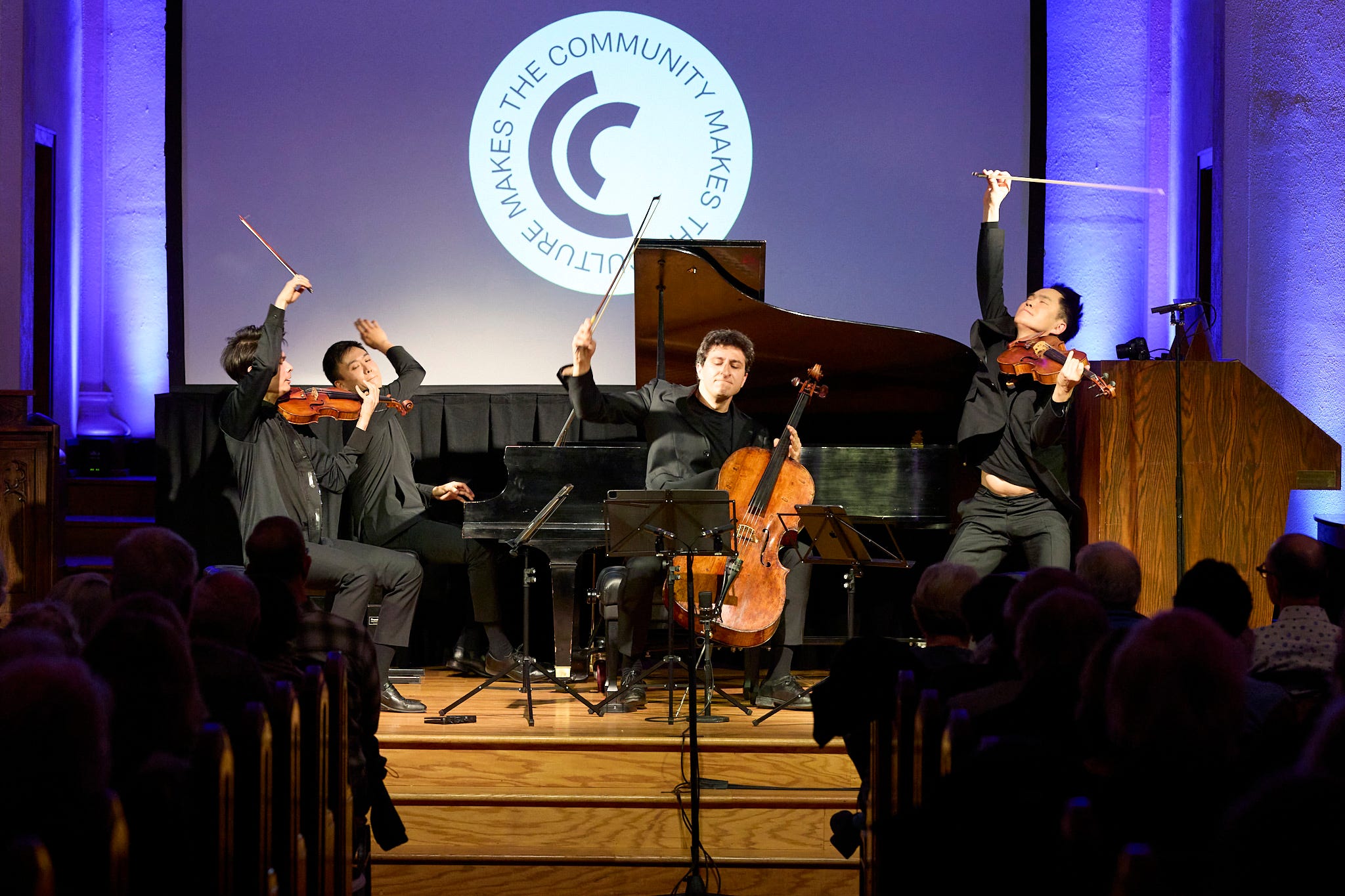
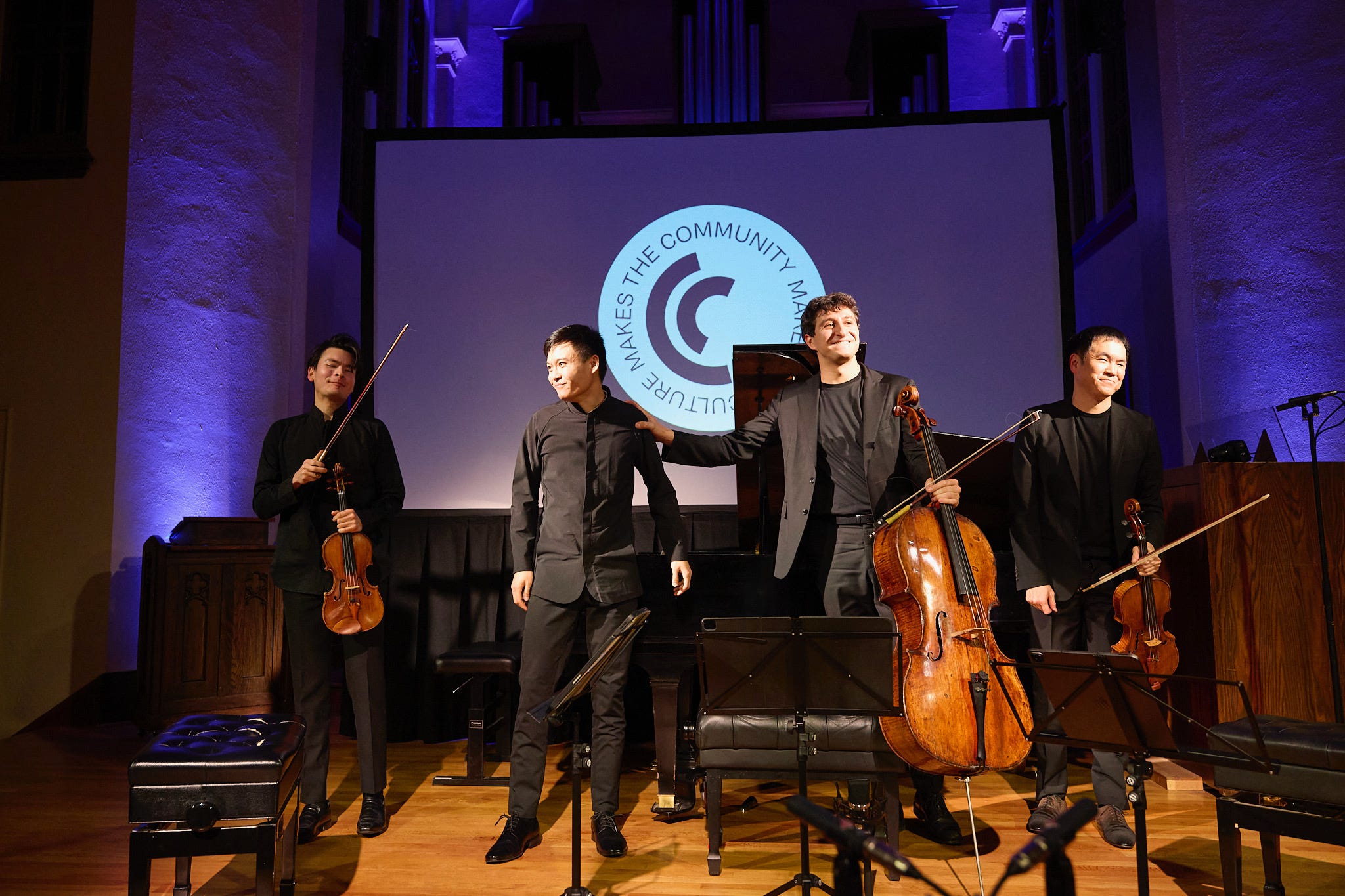
Two nights ago, the Cultural Caravan celebrated its fifth anniversary with a concert including Stefan Jackiw, Richard O’Neill, Kevin Ahfat, and me. I opened the night with a speech, and then we showed a video that I put together with the incredible Mike Grittani. I thought I’d share the speech and video here. (Videos of the concert will be available soon, though likely not on Substack!)
Way back when I first got on Substack—can it really be three weeks already!—I had the idea that this would be a relatively Cultural Caravan-free place. I think the only reason for this is that as the Caravan’s public face—among donors, artists, grant committees, my staff—I have to be the numbers/logistics/organization guy. The language I utilize must be goal-oriented, clear, and succinct—in other words, the opposite of what I’m trying to do through Substack. “Clear and succinct here would be nice, too,” I can hear you thinking. You know what I mean. I’m trying to let my hair down a little, okay?
But as I said, the Caravan is, in so many ways, me. And I am, in so many ways, it. Alejandro Castaño, one of our artists-in-residence this year, calls me “Mr. Caravan!” every time he answers my phone call. (The exclamation mark feels essential to his pronunciation.) This nickname reminds me of a ‘90s children’s TV character called Andy Bandy-Man. Andy Bandy-Man was a sunny miniature man in a wooden box, with a washboard on his front, a bass drum on his back, a harmonica around his neck, and cymbals strapped to the insides of his knees, among other instruments and appendages. Andy Bandy-Man, the One Man Band! Anyway, there’s something about the Cultural Caravan that feels a little like that. Maybe it’s because of the alliterative name that sounds ready-made for a children’s TV program, or that it’s so often referred to as my “little project,” or the quaintness of focusing so locally. Or maybe it’s just that when you’re inside of it and have seen all the struggle of making every little thing happen, that small-time feeling from Day One never quite goes away.
Paradoxically, the exact opposite is also true: after five years of work, marking this milestone feels pretty enormous and, honestly, earned. Further to my point about being the numbers guy, I’ve been collecting them. Here are a few metrics from the last five years:
172 concerts
184 artists
70 businesses, nonprofits, municipalities, and other local partners
250+ individual donors
$850,000 raised and reinvested into the community
6,125 MainStage attendees [since 2022]
117% MainStage audience growth [since January 2024]
I mean…not bad, eh? Can I be proud of this without sounding like a jerk? Or do I even personally identify with it? I was out of town visiting a good friend recently and every time I introduced myself and explained I was a cellist, he interrupted and said, “he also founded and runs this amazing nonprofit in Colorado!” Each time this happened I experienced some form of cognitive dissonance: A Cellist is who I am, the Cultural Caravan is something I do…
Even though it was only two days ago, Thursday has washed away that distinction. The truth is the Cultural Caravan is the manifestation of the best version of myself and my ideals. It’s the most challenging, values-based, exhausting, empowering, draining, and fulfilling work I do. It’s just slightly less trouble than it’s worth—meaning it’s a hell of a lot of trouble, but its worth is even more than that.
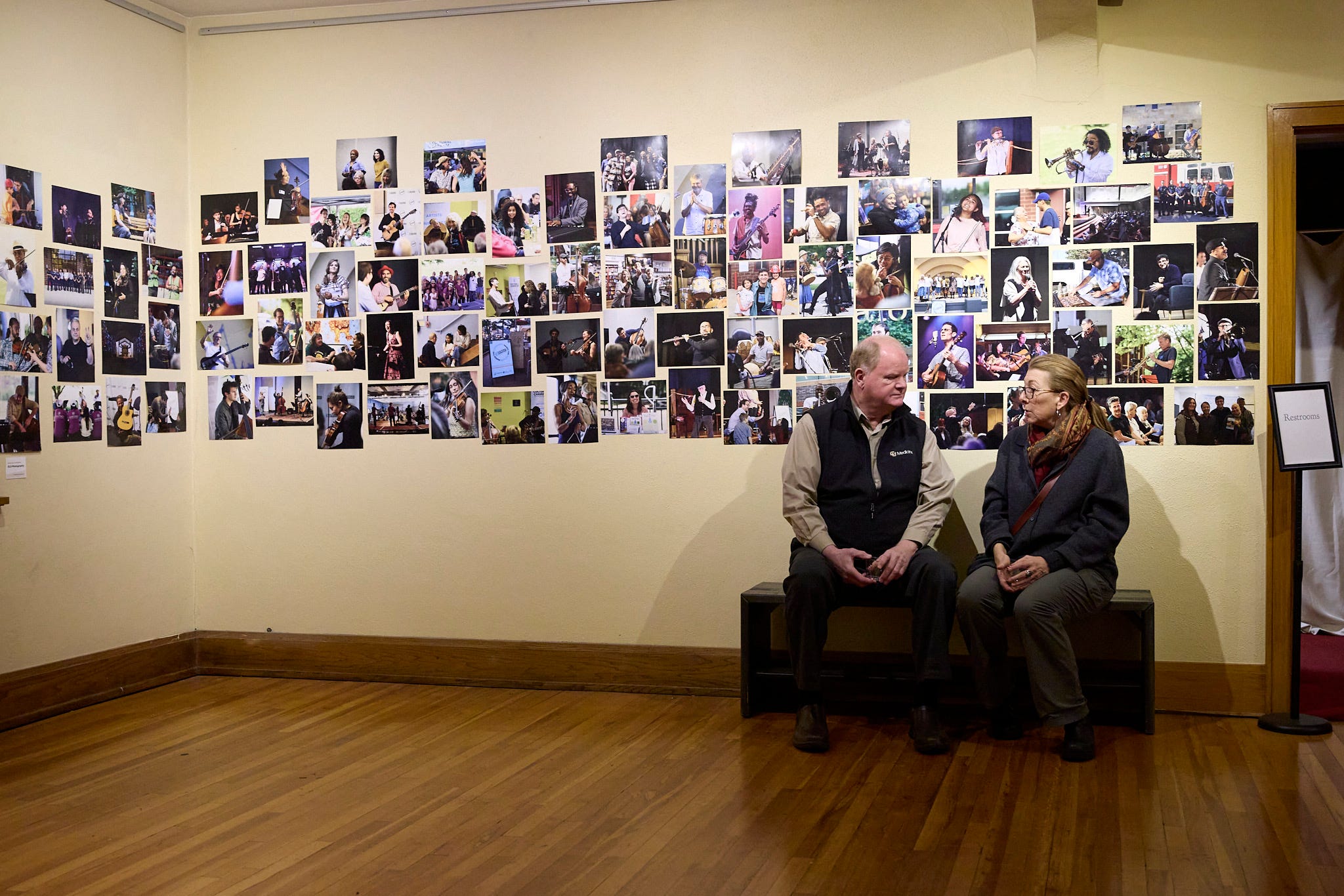
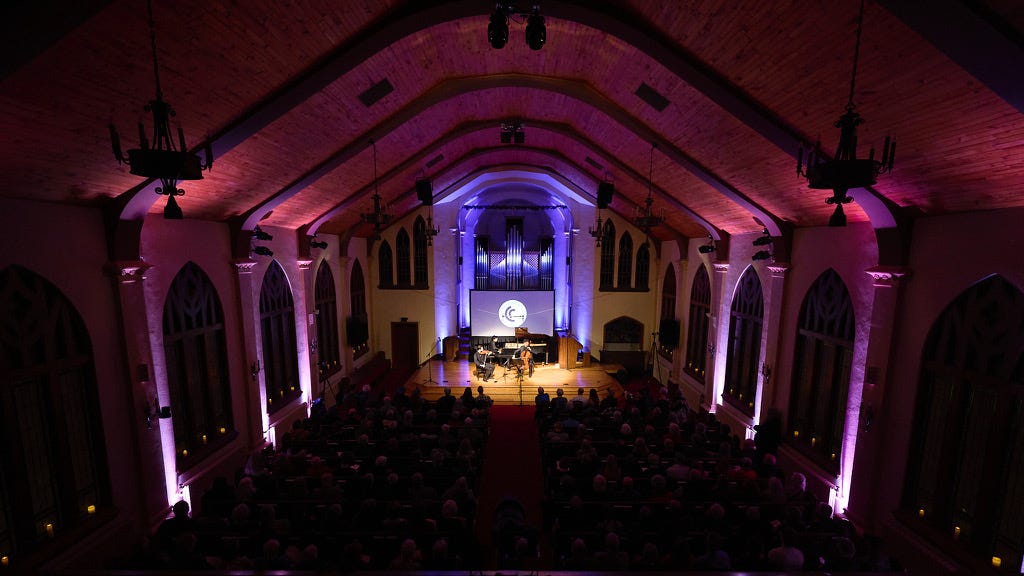
Before the concert started, I did what I often do before Caravan concerts, which is mill around and say hi to folks. I am not exaggerating when I say that out of the 300+ people who were there, I think I knew at least 250 of them by face, name, or both. And really, they’re all so damn nice. And supportive, and grateful to be there, and and and. It’s a good fucking crowd. And because the night was all about celebrating our five year milestone, I couldn’t help recalling how I came to know each person as I welcomed them.
I wrote two speeches for this occasion. The first draft was clear and succinct. The other one, the one I gave, was longer and took the form of a sequence of short stories. I abandoned the short version because it said everything that you’d expect (basically “look how great we are and we’re going to keep being great!”), so even though it was short, every word felt like a waste of time. This longer version includes a lot of characters who have helped make the Caravan what it is, and reserves me mostly as a witness to their heroics. I was a little worried the crowd would get impatient, but I think they stuck with me.
Oh, and the video. Amazing work by Mike Grittani, who in addition to being a completely detail-obsessed artist (a word he’d probably blush at, but there’s no other word for him), has become a really good friend. We interviewed twenty community members back in September and spent hours and hours assembling this video, which I think does a better job than any speech I could give. I’ve attached the video right here at the top, but I recommend reading the speech first because that’s the order the audience experienced it.

[Speech begins here:]
Here’s a story. It’s August 2021. The Cultural Caravan is barely six weeks out the gate, and I’ve made contact with Nadia Artman, who hesitatingly agrees to host us, strangers, for a concert at her farm in Longmont. I promise her what I promise everyone that season: that if she gives us the space, I’ll take care of the rest. I’ve got the ensemble locked down—Gonzalo Teppa, a Venezuelan bassist I’ve known for all of three weeks; and a pianist named Victor Mestas (also Venezuelan, recommended by Gonzalo) who I have not even met yet. We will play trios. (What trios? TBD. Between now and the concert I will learn to play Venezuelan jazz.)
“One more thing,” Nadia says. “I don’t want people in the house”—remember, this was Covid—“so you need to get a port-o-potty.” “Done,” I promise, adding “Learn how to obtain a port-o-potty” right below “Learn Venezuelan jazz” on my to-do list.
So I spend that week learning to play Venezuelan jazz and book portable toilets. The toilet goes the same way everything else does these days (Google it, find a guy, call the guy, pay the guy), but the Venezuelan music is something else. Gonzalo—who is, as Caravan regulars know, a boisterous and limitless personality—welcomes me to his little apartment to rehearse with Victor, who smiles but says almost nothing as he hunches over his electric keyboard, the two of them patiently putting me through my paces while spinning out one brilliant improvisation after another.
Two nights before the concert, I drive up to Longmont to make sure the Port-O-Potty has been delivered as promised. It has not. I call the company but it’s 10 at night, so I get no answer. I call the next morning. Again, no answer. For the next 36 hours I do nothing but wait for the toilet guy to call me back and rehearse with two of the most imaginative musicians I have ever met.
When we arrive at Nadia’s farm the next afternoon, you can probably guess: the port-o-potty is still not there. (Nadia, at this point, is not so thrilled with me.) We cross our fingers and start setting up. The first guests arrive. No sign of a port-o-potty. I tell Victor and Gonzalo that we’re starting soon. Still no port-o-potty. But just as the final arrivals are erecting their lawn chairs, a huge truck rolls up in front of all the assembled guests, our glorious toilet chained like a prisoner of war to the back of a septic tank. I have never been more grateful and mortified at the same time.
The concert starts late. As the sun sets, I join Victor and Gonzalo onstage for a concert that to this day is one of my favorites that I’ve ever performed. Any musician knows how quickly music can transform strangers into friends; that’s what happens onstage that night. And I think the people in attendance understand it, too. At least, Nadia does, because at the end of the night she pays me the greatest compliment: “Next time, I’ll take care of the toilet.”
Another story: City of Lafayette Arts & Cultural Resources and Sister Carmen Community Center join up with us regularly—these days, once every event cycle—to bring together Lafayette constituents, the arts crowd, and Sister Carmen participants for everything from concerts in municipal spaces to interactive marimba workshops at Sister Carmen to summer block parties with food and Latin music.
In this case, we were at The Collective, Lafayette’s city-managed gallery, and were presenting a free dinner with Sister Carmen participants before that evening’s public concert. This is a regular thing we do now, for the simple reason that when we asked Sister Carmen participants—who are frequently excluded from mainstream cultural opportunities—what we can do to help them feel comfortable at our events, they suggested it would be helpful if we got to know each other. Which was like, duh. So now we host these pizza dinners before concerts, which (a) incentivize parents too busy to throw a meal together to bring their kids and (b) give us a chance to gather round a table and talk.
But this was February 2024, and ICE had just begun deployments in the area. The only line of defense for the immigrant community—many of whom are participants in Sister Carmen’s services—was to stay home and lock the doors. 45 people had registered earlier that week for this dinner, and we’d prepared a real spread. Only two people showed.
By contrast, more than 100 (non-Sister Carmen) people arrived a couple hours later for the concert. Even though it was standing-room only, I could only think of the families we had gotten to know, in neighborhoods we had visited, who instead of being here were hiding in their homes, trapped. The pizza we’d ordered had grown cold, and was being picked over by concert attendees who had already eaten their dinners.
After that event, I called Rachel Hanson, the Lafayette Arts & Cultural Resources Director, and offered her an out: “If you feel like resources are better spent elsewhere,” I said, “I understand.” Rachel didn’t pause for even a second. “If we disappear,” she said, “we leave an extremely vulnerable community without safe spaces to gather. If it’s not safe for them to come out, then it’s not safe. But we need to have always been there for the day when it finally is safe again.”
Of course, it’s still not safe. But last week, we hosted another free dinner at The Collective. That very day, reports spread of ICE’s first reappearance in Lafayette in months. 25 people came for dinner. Everyone at the table—our artists included—were speaking Spanish. There was no pizza left when the concert began.
Another story: not playing favorites, but Chris and Margot Brauchli are two of my favorite members of the Cultural Caravan community. They have between them about 100 years of arts patronage and leadership experience, having helped to found the Colorado Music Festival way back in ‘76, with many other impressive achievements in the years since.
As you might expect, classical music is their bread and butter. But I gotta pay them credit: they show up to all kinds of stuff we do. I’m not convinced it’s entirely on purpose—I often think Chris knows a concert is happening but hasn’t bothered to check out what concert it is—and my favorite thing about them is that they’re honest. Sometimes, Chris really doesn’t like or understand what he hears, and says so. I think this is because we consider each other genuine friends—but also, he’s 92 and has no reason to give a damn anymore. (I’m going with the “friends” reason.)
So, one time last season, he emailed me: “We weren’t fans of the music tonight so we left before the end. Next time you’re in town, however, it would be fun to get together and learn what is appealing about the music, which obviously has great appeal given the size of the audience.”
I want to be clear: I think this is great. What could be better than being in your tenth decade, as a die-hard classical music not just fan, but aficionado, giving something new a try, responding honestly, and still, nevertheless, remaining curious? This is model behavior.
When I got Chris’s email, I was on a plane, minutes away from takeoff. But I was fresh off the residency week with this artist in question, and had the benefit of what these residencies afford: I had learned so much about their music. In short order I tapped out 500 words about this artist’s homeland, their culture, and the distinct function of their music as a collective joyful salve to colonialism, suppression, and pain.
What I also realized—and confessed in my email—is that Chris and I are the same. We’d be very happy on the same desert island with only Bach and Schubert and Brahms. His bread and butter is my bread and butter.
And this is the ultimate beauty of the Cultural Caravan, and what I wrote in the closing line of my email. “This has been the great gift of the Caravan in my life,” I wrote, “which I hope to share with anyone who wishes to take part: to meet and spend a little time learning about extraordinary people from cultures you would never seek out or chance upon on your own.“
This is perhaps one of the more subtle components that distinguishes the Cultural Caravan from other organizations: when artists get a chance to headline, or do a residency, they’re really getting an invitation to curate. I don’t tell them what I want to hear, or what I think the audience wants to hear, because I think we find inspiration in seeing artists inspired. The clearest voice sings the most beautiful song. And in this way the Caravan is never—will never—be just one thing. It’s a kaleidoscope—each one of us, including all of you, a little mirror within the whole, revealing something different and new, depending on when and where and how we catch the light.
It’s five years since the Cultural Caravan’s first frenetic day, but for me, the Caravan’s story begins a little more than two years earlier. It was 2018, and I was in a funk. Trump had become president, and music often seemed a world away from our reality. I set myself the challenge that summer to take my cello on a road trip through Colorado’s small towns. I wanted to see what happened when I was among so-called “ordinary people” out in the so-called “real world.”
I performed in bicycle shops, cafés, saloons, the maximum-security prison; I played Bach on the back porch of a house belonging to a guy we’d now call a MAGA/MAHA Jew for Jesus. I made incredible personal connections everywhere I went. Venturing into these different spaces with music, it was possible to penetrate whatever barriers of judgement or mistrust existed and connect in ways I couldn’t if I had been a journalist, or a politician, or whatever I considered at the time “more useful.” In Gunnison, I wasn’t allowed to pay for a single meal. In Bayfield, that Jew for Jesus took me to brunch, and by the time he signed the bill, he was reconsidering his notions about the Iran Nuclear Deal!
It’s only recently that the thread from then to now became apparent. It’s ironic that I ended up using the lessons of a road trip to build an organization so intent on staying put. The Cultural Caravan, after all, is about being hyper-local, getting to know your neighbors, maybe even deepening the definition of what that word, “neighbor,” and “neighborliness,” means. But the essence of the lesson is, music—culture—holds the keys to the most closely-protected interior spaces within each of us. When we share melodies that mean something to us, or sing songs from our childhoods, avenues for understanding that were not visible before reveal themselves.
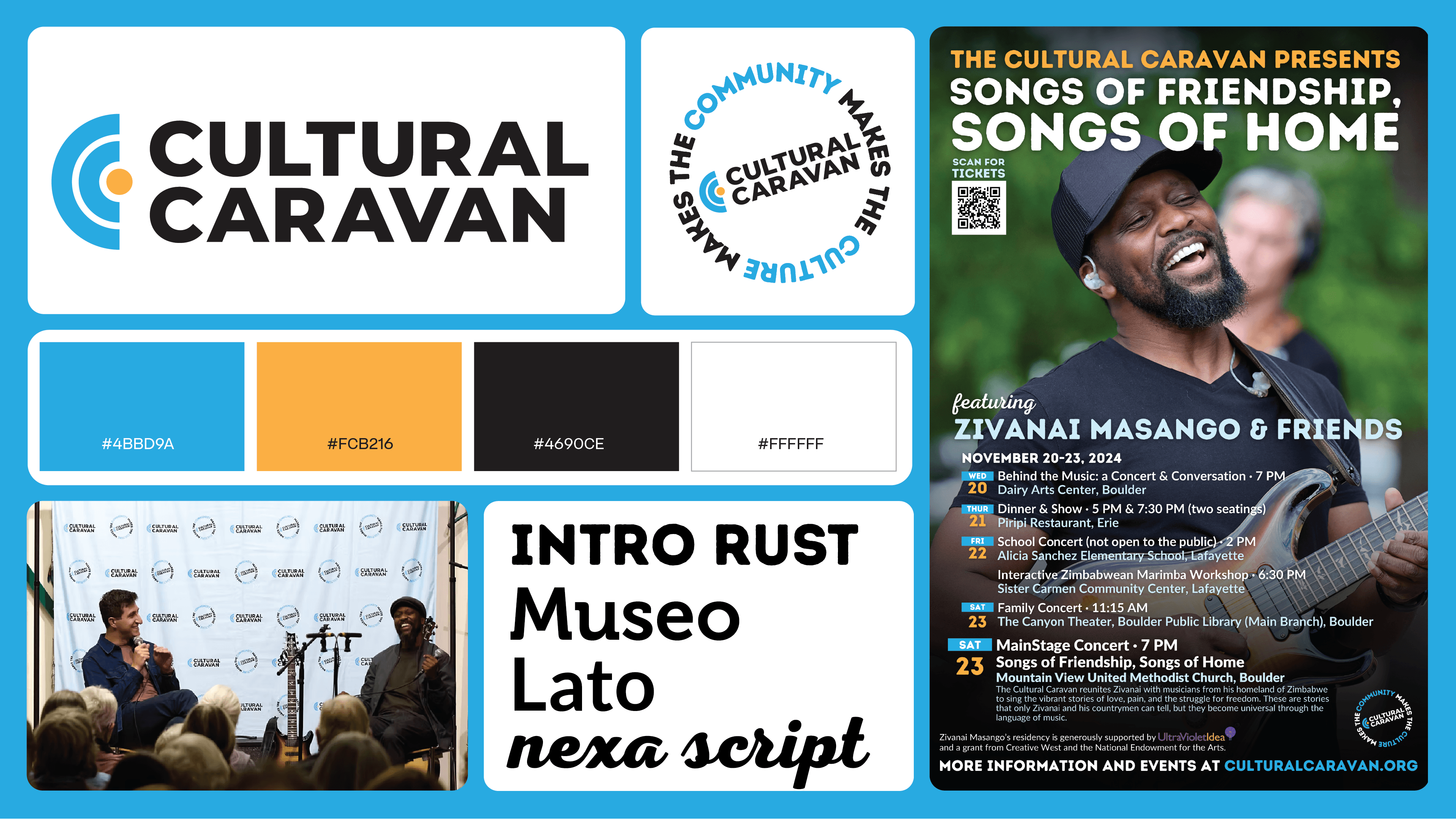
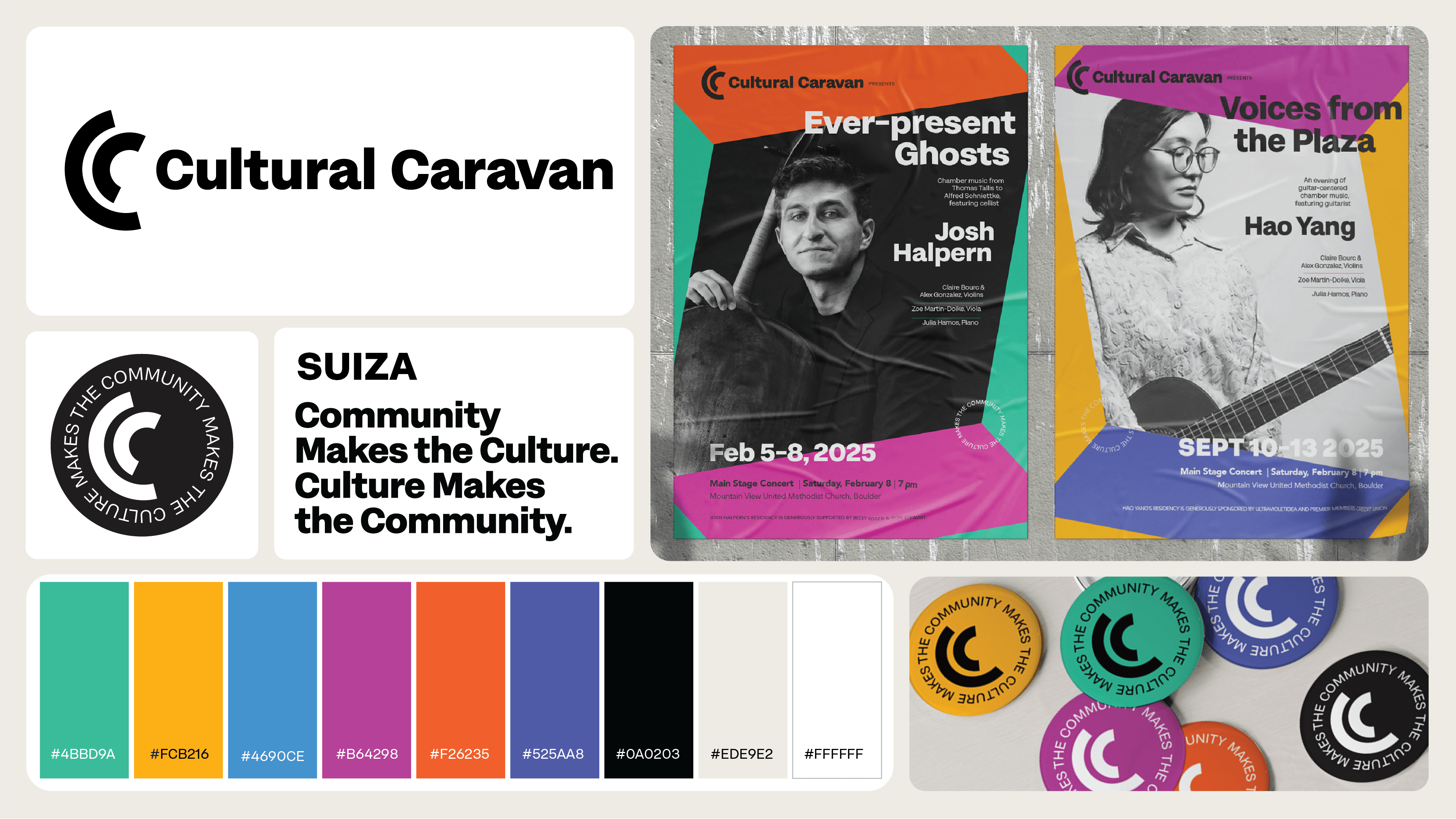
Once the small, scrappy startup, the Cultural Caravan is now a rich and complex network of such avenues. In five years, we’ve presented 172 concerts with 184 different artists, working alongside 70 local partners and reinvesting $850,000 into this community. Until recently, we were sprinting on a tightrope—organizing and executing 40+ events per year with a team of just two people. But at this five-year mark, the Cultural Caravan has shifted into a palpably different chapter. Check out that staff list on your programs and you’ll see the names of six people whose energy and passion I wouldn’t trade for anything. Tonight also marks the debut of a brand-new visual identity that communicates the vibrancy, accessibility, warmth, and polish that you’ve come to expect from our programming. Compared to our previous identity, which was quieter and more traditional, this system evokes who we’ve become: a dynamic, world-class cultural force.
Perhaps you’ve noticed that I’ve largely avoided talking about the next five years. But, at least from my perspective within the kaleidoscope, this is the Caravan’s future: continuing to ensure that our essential character—so beautifully modeled by the friends I’ve told you about in these stories—that that never changes, and that we become the arts organization known for consistently delivering the broadest possible cultural diversity at a peerless level, where everybody—whoever you are, whatever your background—is welcomed, entertained, challenged, dignified, and connected.
And so, on this milestone anniversary, let’s double down on five bigger, brighter years. By recognizing, yes, musicians of all stripes, but also shopkeepers, city employees, food bank volunteers, and you—as individual wellsprings of culture, and building the means by which we all work together. And to do it while remaining steadfastly committed to the idea that everyone who wants to be here can afford to be.
Speaking of which, there are some others I’d like you to hear from.1 And then we’ll get to the music, I promise. Thank you all for making tonight possible.
This is a reference to the video, not other speakers.