

Soooooo…we’re now at war with Iran, apparently! What a thing to wake up to on a Saturday morning!
…How about some music therapy?
I don’t mean to be so pat, but it’s like February swallowed me ass-up into one of the shit-gray snowbanks that every avenue in New York has stubbornly sported this month like an awful pair of mutton chops. (New York Winter is not my thing.) I mean, I got to make good music over the last few weeks, spend time with friends, open myself to some exciting new opportunities—but you know when a storm is about to come, the barometric pressure drops, and you just feel tired and dizzy? That’s how this whole month has been for me.
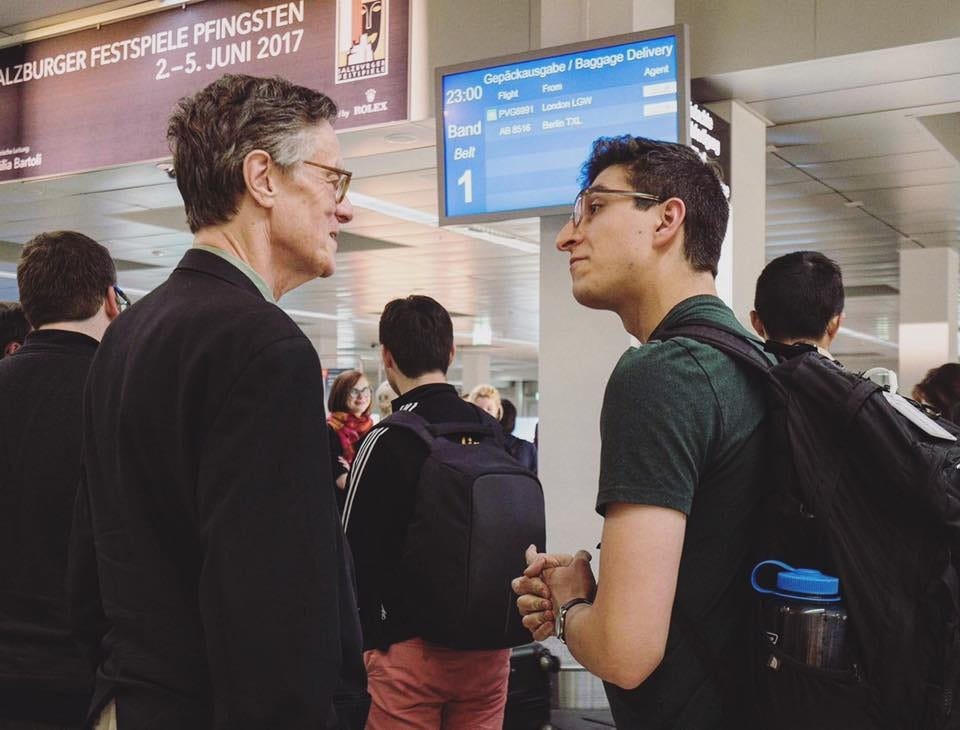
Six years ago this month, the world lost Peter Serkin, so I thought while I’m still under the weather and the wire I’d get this retrospective in. I was lucky to perform with him on the Curtis Symphony’s European tour in 2017, when he joined us for Brahms’s D minor piano concerto. I found him utterly magnetic and charmingly anachronistic: consistently warm and humble, professorial in a tweed jacket and tie, and so unlike our orchestra (bursting with ambitious young guns trained on clarity and virtuosity) in his approach to the music. He was unpredictable, changing the subtleties of his interpretation from night to night and effusing Brahms’s grand passages in wild (occasionally messy) gestures rather than note-perfect pronouncements. His phrases contained that unique quality of pure invention. And he so clearly wanted to play with us. As principal cello, I had a direct line of sight to him, framed by the piano’s open lid. There were many moments in each concert when he would look at me, not in an effort to tell me what to do or scold me for missing a cue, but to invite me to join him on some new idea. As a result I kept my eye on him more or less constantly—some in the orchestra may have interpreted my behavior as sort of kiss-ass—but I didn’t want to miss a beat of what Mr. Serkin was doing. It was all I could do to keep up with the continuous conversation he was having with the music, and with us.
During that tour, I was going through some heavy personal stuff. The constant activity of that trip was a good distraction, but it wasn’t enough to alleviate what weighed on my mind. But when we played Brahms with Mr. Serkin I could count on forgetting all of that. His spirit and inspiration was more than a dopamine hit. It was an affirmation of everything that is so great about living and feeling. He held us in a magic spell.
A number of us students were tasked with recording the events of the tour, and I volunteered to interview him. He was reluctant to sit down and talk about himself, but I finally convinced him on tour’s final night. Between the sound check and the concert, we met in his dressing room and I switched on my audio recorder. We talked about his upbringing, his education, his inspirations, things he was currently obsessed with, and after about 30 minutes I thanked him for his time. I knew he’d been reluctant to talk, and I wanted to let him prepare for the concert, so I was surprised when he said, “Let’s keep going. I’m into it.” We talked for another half hour.
Transcribing an hour of audio is tedious work, and I got a little lazy, so it was never published in Curtis’s Overtones magazine. This month, I finally revisited the recording and, in drips and drabs, edited our conversation to share here. I must confess, now that I host onstage interviews somewhat frequently, I’m not so proud of the job I did here—I basically allowed Mr. Serkin to meander wherever he pleased, and you’ll see that many of my questions don’t get full answers. But I got to spend an hour speaking with a true artist, and though he just sort of ambled down memory lane as I tagged along—his fluid voice sparkling with recollections of so many people he loved and admired—I still cherish the experience. I hope you’ll find something in it, too. Throughout the transcript, I’ve attached links, photos, recordings, and videos of the many artists he references so you can dig your own rabbit holes.
In 2019, I was supposed to tour a program of piano trios with Mr. Serkin and Viviane Hagner, but by then he was too sick to join us. I had been looking forward to that tour so much, of course, and was so sorry I never got to play with him again. (Adam Golka, a terrific pianist and friend, stepped in and it ended up being a very special tour anyway.) I was tentative about reaching out and disturbing Mr. Serkin while he grappled with his illness, so I just sent him a brief text message—a tiny fraction of what I would have liked to say.
Before you read the interview transcript, please listen to the recording of Mr. Serkin playing the Aria from the Goldberg Variations, linked at the bottom of this introduction. This performance took place not much more than an hour after our conversation concluded. He had already performed the Aria previously on the tour, and later told me he’d been planning a Schubert dance for this particular evening, but I had asked him about Bach and told him how much I loved his performance, so as he returned to the piano, he gazed at me. I don’t think it’s too much of an exaggeration to say that this performance was for me. I had no way of knowing it would be the final notes I’d ever hear him play. It’s one of the most precious things I have.
Shortly after Mr. Serkin’s death, I discovered he had a Youtube channel. (It had only a handful of subscribers and each video only had about a dozen views, so it really did feel like a discovery.) It contained no archive of professional recordings, or highly-produced video, but—to my joy—thirteen simple videos, each no longer than a few minutes, featuring Mr. Serkin just out of frame, dressed in a rain coat, phone perched on a brightly-painted upright piano on a street corner. Above the hum of street noise, Bach preludes, inventions, and sinfonias rose like a descant from the beyond. I have yet to find more enjoyable music-making on the internet than those thirteen videos.

I hope you enjoy what follows—there’s plenty of music in it to fill a weekend!
Peter Serkin’s Aria in Wrocław, 2017:
[Here’s the transcript of our conversation, edited for concision and clarity. I’m in bold, Mr. Serkin is not. We pick up mid-conversation, as we were discussing wind intonation in the orchestra.]
I was pretty out of tune.
Nothing’s ever really in tune on the piano, I guess, because of equal temperament.
Which I don’t go for.
What do you mean?
I’m not on a crusade against it, vehemently, but I prefer the old tunings. The unequal temperaments. Before they scientifically sliced it into 12 equal parts.
When was that?
Thousands of years ago. The Chinese probably did it—the Greeks did it. It’s not a 20th century invention, but it’s a 20th century orthodoxy, and that’s my issue. I don’t mind that it can be done scientifically and efficiently—but it eliminates key coloring entirely. That’s why I’m trying to bring it back!
You have to become your own piano tuner!
I have some sympathetic tuners. I sometimes encourage people I don’t even know to try it.
Is your piano at home tuned unequally?
Yes. It can accommodate all the keys and you can still hear the difference between the keys. The keyboard instrument is historically an instrument in C. C is the purest. The further you get away from it in the circle of fifths, the more you’re going to hear differences. So with G-flat major, you’re going to hear wolfs and vibrations.
And composers kept that in mind a little bit?
Not a little. A lot.
Also, the modern piano’s entire range has been adjusted to sound more or less the same. The older pianos, in color and tone—
—Oh, I see, in timbre, yes. When you have the difference in keys to begin with, a lot of those differences in timbre come out by themselves. In Schubert, there’s so much modulation that just sounds like repetition to us because it sounds identical. The performer can try to manufacture nuance or some kind of fancy perfume to try to make the differences in key color, which are inherent if the keyboard is tuned in the right way. You [string players] make these adjustments all the time. In fact, if you play with unequally-tempered keyboard instruments, you will adapt with your ears.
I’ve snuck this into a few orchestras without the players or conductor knowing! It was supposed to be a blind experiment—nobody knew about it but the piano tuner. We were playing the slow movement of the Brahms B-flat Concerto. Before the cello comes back in F-sharp major, there’s this beautiful song, a quote from a song by Brahms in F sharp major. (So very remote from C major, F-sharp.) The clarinetist came to me and said, “For the first time, we were able to play that high A sharp and it wasn’t too sharp. It matched the piano.” She was incognizant of the fact that the piano had been tuned differently. So I told her.

None of us hear things absolutely equally. If we do, it’s because we’ve trained with some kind of robotic device—
—Or playing with a piano that’s in equal temperament, equally out of tune! But [Pablo] Casals didn’t play like that. [Joseph] Szigeti didn’t play like that. How come we’re talking about this?
I don’t know! Let’s get started, I guess! The obvious place to start, since I’m supposedly doing this for Curtis—
Are you? In what capacity?
If we end up with anything good, maybe it would go into the Overtones magazine.
That glossy magazine. We never used to have anything like that.
You never know, if it’s really good you might get on the cover.
Oh no.
The first question—maybe boring—is: what’s it like to be on tour with the Curtis Symphony Orchestra?
It’s not boring by any means. It’s been inspiring. Not only the tour, but the rehearsals in Philadelphia is the part I cherish the most. I love that we had enough time to rehearse, and discuss, and try things.
Tell me more about your perspective on that time.
Well, first, Osmo Vänskä is such a treat. He’s such a wonderful person with such integrity. He’s so straightforward, so open, considering and reconsidering the music all the time—which I love, rather than trying to solidify a performance. That often happens these days—people try to perform their performance of a piece, and the piece itself is incidental. It’s about how they want to come across. This other approach is much healthier. It’s an ongoing process of questioning. Being willing to say, “I don’t know, let’s try something else and see how that is.” We do that in rehearsal, and sometimes during travel. A violist asked today, “What can we do differently?” I said, “You can use more bow in those tremolandos in the opening tutti!” But more often, it’s on a different, nonverbal level, just on the spot.
From night to night, there’s so many different little changes in your interpretation. It makes everybody perk up—we flash each other a look, like “listen to how he did that tonight!” And we adjust. How do you avoid building a fixed interpretation?
I don’t manufacture any kind of preconceived notion that I’m going to do it differently tonight. At the same time, I’m not holding steadfastly to an intention. The music does it, it seems—it changes spontaneously and I just try to be open. Sometimes I get into trouble playing with chamber groups, because I shift the rug without warning. But I can’t warn them because I don’t myself know.
My teachers were very creative when they played. I had three teachers at Curtis—Lee Luvisi, my dad, and Mieczysław Horszowski. All three very interesting pianists, very different from each other. You really didn’t know with my dad. He would advocate tremendous preparation, but then he advocated going out on stage and forgetting everything. With Horszowski, there was something special. You felt he was creating something on the spot, not for the sake of showing off his creativity, but just letting the piece unfold, allowing it to be creative.
Did he play in your lessons?
He played a lot. That was the best part. He didn’t lecture. Horszowski had studied with Theodor Leschetizky when he was young. Who studied with Czerny, who studied with Beethoven and Hummel. And Hummel studied with Mozart! But that’s no pedigree on my behalf. I can’t say that one drop extends to me.

Why would you say that?
From generation to generation, things get changed and distorted. Memory is not reliable. I certainly don’t play like Horszowski—I wish I could! Who knows how Beethoven played? We weren’t around. However, it’s a precious lineage.
You not only come from an amazing lineage of teachers, but also an esteemed musical family. What was that experience like? When did you start at Curtis?
It was in fifth grade. We were already living in Philadelphia, because my dad was teaching there. Efrem Zimbalist was director, and my dad was head of the piano department. Lee Luvisi, Eleanor Sokoloff, Horszowski—those were the other main teachers at that time. I auditioned kind of informally for Efrem Zimbalist. I’d been studying with Lee Luvisi privately for a couple of years. It was felt that I could benefit by going to a real music school.
What was Lee Luvisi’s story?
He didn’t stay that long. I think he found it claustrophobic there, having been a student there. And my dad was an imposing figure. Lee wanted to forge out with his own individual life—go back to Louisville with his wife, teach at the University of Kentucky, continue to play. I’ll never forget the way he played—even when he was a student, I heard his Schumann Carnaval, Chopin B-flat minor sonata…many great things.

I was so lucky to be exposed to all kinds of great players. I went to the Philly Orchestra every Saturday night, of course. If it was a program that really interested me I’d go Friday afternoon, too, and sometimes to rehearsals. [Eugene] Ormandy was music director. [Otto] Klemperer was a memorable guest conductor—he spent three weeks there—and I snuck into his rehearsals. His daughter knew me and she liked that I wanted to hear what he had to say.
What did you hear from him?
Beethoven—the Eroica, Pastorale and seventh symphonies. He did the Egmont Overture. Brahms’s Third Symphony, Schumann Fourth.
I’m impressed by your memory!
He was a tremendous force of energy. He’d been through strokes, he had trouble walking, trouble talking. Some people scoffed at him. The orchestra played twice faster than he conducted the Pastorale at the first rehearsal. So he did it over, and did it quite slowly. But it sounded so right when he did it.

Have you tried to replicate that in your own playing?
Tried to, yes. It was an influence, hearing him rehearse and conduct. His careful ear for the balance of instruments. You’d hear even more detailed inner voices. Clear counterpoint and beautiful balancing of everything. Very characterful, full of energy. Which is what I love in an orchestra. I think the Dresden and Berlin Staatskapelle Orchestras have that.
You were speaking the other day about both of those orchestras being more traditional.
They were insulated because of the horrible Nazi years, and then Russian years. In a way, they were protected from being overly influenced by hearing very impressive international orchestras that were perhaps more anonymous and uniform in their approach. These orchestras have preserved a way of playing where every player is playing chamber music. Every cellist is playing in a string quartet, all the time. Nothing’s routine. I did the Beethoven Triple Concerto with the Berlin Staatskapelle, and when the cellos and basses started—[mimes the opening of the piece]—it was tremendously thrilling!
We were discussing your musical family, this huge lineage of teachers with whom you started at such a young age. But there’s no sign of copycatness in your playing. It seems to come from such a pure individual place.
You think? In another sense, I’m applying what I learned. I studied [the Brahms D minor concerto] with Karl Ulrich Schnabel and remember everything he had to say about it. I’m not disagreeing with you, but the teaching was invaluable. I heard my dad play this Brahms when I was maybe 11 or 12.

Was it complicated to study piano at the school where your father taught?
Oh yeah. Complicated and discouraging. He could be very negative.
To you, or in general?
To his sons, I think. And to me in particular. I don’t think he really wanted me to play piano. He felt there was too much suffering involved. He himself suffered. He would have preferred for me to conduct, maybe. That was his ambition for me.

My mother was Adolf Busch’s daughter, and I loved my grandfather very much. As a person, he was so warmhearted, so generous, and so easygoing. He had me walk down to his house with my fiddle case and we’d play two violin pieces.
So you started on violin, studying with him?
He just played with me. He loved to play with everybody, anybody. He didn’t take himself so seriously. He took music tremendously seriously. Maybe because he died when I was so young, and that was so disturbing, I gave up the violin. That, and the painfulness of having the E string so close to my ear! So I switched to piano, and my mother helped me get started, and she was very encouraging. Blanche Moyse—Marcel Moyse’s daughter-in-law, who was really a violinist, and a student of my grandfather’s—taught me piano in the beginning, plus music theory, and gave me good training in solfege, harmony, counterpoint, the clefs, reading vocal scores, and figured bass.

Were you enthusiastic about all that as a young kid?
Very. And I felt it kind of ingenious that my mother got me to play Tartini and Sammartini and Geminiani with her from old editions that didn’t include [the violin] part. It was simply the figured bass. I had to learn from an early age how to realize harmony from figured bass. I think that’s good training. It maybe isn’t done so much anymore, but could be revived. Should be revived.
So if your father was so discouraging of you playing the piano, at what point did you begin studying with him?
I was…thirteen? My parents called it climpering—Yiddish for fooling around at the piano. I loved to sightread. I would take choral and chamber music scores and just read them at the piano and not necessarily work them out. I was just getting to know the music, and they frowned on that. I was on my own on an upright on the fourth floor, and sometimes they’d overhear and not always approve. I should be practicing. I should be doing scales like my dad did—arpeggios, trills, and so on.
Did he force that on you?
He encouraged it, yes, but so did Lee Luvisi. They all practiced scales. Horszowski too. But always making music. Some players in this group, if I may say, could cultivate a more listening-, more aware-style of warming up. You’re warming up your mind. Some of what I hear is mindless—just loud, trying to play louder than everyone else onstage. I would prefer if they tried to place softer than the softest person they can hear onstage.
I saw some people in the audience at our Salzburg concert plugging their ears as the orchestra was warming up. I stood up and walked across the stage to the associate concertmaster and said, “I think maybe we should play a little softer.” A lot of people just stopped playing altogether. It got really awkward onstage.
That can be okay too, to just be quiet for a while!
What do you do when you warm up before a concert?
I do what my dad used to do, but not as fanatically. He told me that he overheard [Sergei] Rachmaninoff practicing, playing very, very slow scales—not loud, not fast. That impressed me, so I try to apply that, being very sensitive to the scale steps as I go along—that is, not making it physical exercise, but rather listening to every note, like it’s music.
You mean the scale steps, as in the intervals?
Yes. Outlining the octave. The fifth in the middle. The fourth leading to the fifth. You know, the obvious. The second degree is the passing tone to the third. The leading tone connects to the next octave group. Making rhythms out of it. And sometimes different articulations, which I learned from Marcel Moyse, who was a big influence on me in many ways. And then then you’re ready to play something by Bach, maybe. That’s what I like to do.

Can you tell me about your approach to Bach? Your encore in Dresden, the Aria from the Goldberg Variations, was—and I’m not trying to suck up to you right now—but it was honestly one of the most beautiful things that I think I’ve ever heard. There were times when I was almost worried that you had forgotten something because it sounded so invented, so of the moment.
I’m not sure what to say about that! A lot of it’s not particularly verbal, conceptually. I can say what it isn’t. It’s non-mechanistic, non-motoric. At the same time, it’s rhythmic—with malleability to the room, a little flexibility. There are impulses and motion, places of rest—like in speaking. Something natural that I sensed when Casals played. Sasha Schneider, the violinist, too.
Where did you meet Schneider?
At Marlboro and in New York, and just personally—we were very close friends. We almost had a sonata duo team going, when I was 14, 15—he was in his 50s or 60s. It was a great experience. He was a wonderful musician. His recordings of Haydn Quartets are marvelous.

You were playing with so many seasoned artists already in your teens.
I was lucky, Some I was related to—Uncle Hermann [Busch] was the cellist in the Busch Quartet. I didn’t even realize, they were just there—Uncle Hermann, my mom, Sasha. I wasn’t in awe of them. Maybe I was able to learn more easily from them because of that.

Those traditional barriers between teacher and student were eased a little?
I’m not so much of a Democrat when it comes to music.
What do you mean by that?
I like the idea of being an apprentice, being tutored by a master. And just being quiet—almost empty—to receive whatever teaching there is. That being said, now that I’m a teacher, I learn so much from students—in a sense, the barrier is not there. And playing with the Curtis Orchestra isn’t like playing with students. I’m learning so much all the time, I appreciate it.
Speaking as a member of the orchestra, that is palpable. That mutual respect and enthusiasm for what you’re doing, for us—we’ve had other soloists where that sense is not there. And the response from the orchestra is much different.
I have that experience with all kinds of orchestras. Both renowned orchestras as well as orchestras that are not well-known. I’m always able to communicate and take in what they’re doing and appreciate the best of everything everybody’s doing. Share the moment.
You don’t walk onstage with a soloist’s personality. What you said at the very beginning of our conversation about it being about the music and not about how an artist is presenting himself or herself onstage. You’re there for Brahms and also for the communal experience.
It is social in that way. Orchestra players pick up on it and there’s good communication. It’s not a question of mugging—as some people make a show of how they’re communicating with each other.
Let me change course for a moment. You took a break from the piano—or from performing—in the 80s, right? What made you set it aside?
I was 21. I was experiencing a lot of discontent, and a lot of questioning: Is this really what I want to do? I was getting so nervous for concerts, feeling the pressure—all kinds of aspects of it were disturbing and made me restless. I wondered what it would be like to be free of all of that, to not even identify oneself as a musician, to just be a regular person? I went to Mexico. I needed to enjoy just being alive. It’s not like I was getting rid of music, but I just thought, I’ve been doing this so long—
—Already at age 21!
My mind and body needed a gap. And I wasn’t intending to come back to it. I wanted to let it go and see what that was like. But I couldn’t. It was impossible.
You couldn’t let it go?
No. I was still going through the Goldberg Variations, practicing in my mind. Hearing things on the radio, which inspired me. But it was a good part of a year where I hardly played at all. And then it was offered to me to learn the Berg Kammerkonzert, which is a complex piece for violin and piano and winds. Leon Kirchner was conducting, Pina Carmirelli was playing violin. So I started to practice scales again, a little bit of Bach, and study the Berg.

I found that I was much more open, having been emptied from the experience of not playing, I was much more receptive, more able to learn thoroughly without as much agonizing effort. Appreciating the score, taking it bit by bit, feeling that there was all the time in the world to learn.
When you decided to step away from music and go to Mexico, was there any part of you that thought maybe dad was right about this business?
I can’t really speak for him. There were always questions in my mind. Even now, I’m pretending to be a pianist.
You put on a pretty good act.
I love music. I just want to play music. That’s the point. I love to play with other people. It’s a thrill. The piano aspect of it doesn’t interest me so much. It does and it doesn’t. I love old pianists. New ones, too. I learn so much from them. But still, it’s incidental to an inner drive to learn about the great composers and their compositions. Wondering about, how did that come about, what was going on in their minds, to make them compose in that way? To try to see what the alternatives might have been, choices they made, appreciating more and more. And all kinds of composers—from very early ones like DuFay, Josquin, Monteverdi, Palestrina, Schutz—I love these composers. And then to living composers too. Now I’m older, so many of those living composers are dead, unfortunately.
Who did you have close relationships with?
Well, in terms of their music, I could include Messiaen. I didn’t have a close personal relationship with him, but I knew him and played for him, but he wasn’t a close friend like Takemitsu was. Takemitsu was my best friend, in a way. Oliver Knussen, too, a very close friend. I knew Stefan Wolpe, whose music I love. I met Stravinsky and heard him conduct several times. Went to his recording session sometimes. It wasn’t like we drank together, but I was around him. I’ll never forget his conducting. He’s put down as a conductor, but I thought he was great. Tremendous sense of rhythm, as well as everything else—an aliveness. The freshness in his conducting was unforgettable. I never knew Arnold Schoenberg, but I love his music. I feel close to that. I feel close to Webern. I played a lot of music by—at that time—living composers. I got in a lot of trouble for that.
A lot of trouble for what?
For disturbing people by playing modern music. Now, it seems funny—if I talk about Schoenberg, it’s almost like talking about Brahms. He’s loved now. Not just for Verklärte Nacht, but we can hear how beautiful all his other music is too. But in those days it wasn’t valued, you see. It was frowned upon that I would play so much of it.
By audiences? Or by friends, or teachers?
Some teachers were encouraging, even if they weren’t totally into it. I always gave the audiences much more credit. They were open, and given a chance to hear the music often, they would respond. It was more the know-it-all critics, administrators, presenters, and record blahbity blahs.
“This won’t sell.”
They resented some upstart, actually genuinely loving music of our own time. As if it was a repudiation of the great masters of the past, which is absurd. And would have been absurd in the past as well. Vienna and Salzburg love to take credit for all kinds of things, but they’re hypocritical. Schubert was poor. Mozart was neglected at the end of his life. Beethoven was regarded as an alcoholic madman writing crazy music. Not to mention Arnold Schoenberg—a Jew writing revolutionary music. People were horrified.
Are there composers who you got to know, or whose works you got to know, who you feel in whatever short amount of time has passed haven’t gotten their due as much as they deserve?
As much as they deserve? All of them. They deserve so much. But yes, Stefan Wolpe—one doesn’t hear so much of his music. Difficult to learn—but so is Mozart! It’s well worth it.
Well I just want to get this on the record and say this to you to close: I can only speak for myself, but I know that I speak for so many members of the orchestra, how enlightening of an experience this has been to play the Brahms concerto with you. We’re going to give it our all tonight, but it’s going to be a time that I won’t easily forget.
Me neither.
I hope that this isn’t our only interaction on stage.
I hope so too.
Brahms: Piano Concerto No. 1 in D minor, Op. 15 — II. Adagio (Peter Serkin, Curtis Symphony Orchestra, Wrocław, 2017)
Wonderful, Josh. I very much loved the street piano, the chirping birds, and the imperfections of pitch and mechanics. It seems a metaphor, doesn't it? Thank you!